Sunday, July 17, 2011

Lord, I have SMAD. Someone get a bucket of ice water...

I have the makings of what could be a serious problem: SMAD. (Sewing Machine Addiction Disorder). Now, granted, THIS ONE WAS NOT MY FAULT!!! Really, we'll blame the members of my parents' Sunday School class for this one...

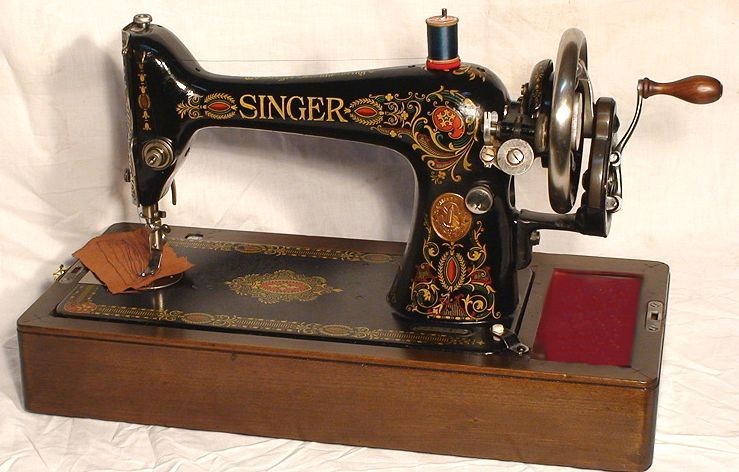
Everyone, meet Lydia, a Singer 301 (the "big" sister to the Featherweight 221), made new in 1977.

**Edit: not new in 1977, bought in 1977? Maybe? This is a 301, meaning it was made between 1950-51, 301As were made through '59**


The back story:

Lydia Rucoba was an amazing lady who was one of those saints of the church. She and her husband Rudy started a ministry outreach project in one of the poorest apartment complexes in North Dallas that led to the church renting 6 (?) apartment units and having weekly Hispanic church services, Bible studies, and after-school programs for the residents. She passed away not too long ago and her husband is now living in an assisted living facility. They had no children and no really close family to help, so my parents' Sunday School class has been helping clean out/sell items in their home, and ultimately the house, to go toward Rudy's long-term care.


Anyway, the ladies of the Sunday School class held the machine for me, thinking I might be interested. I was doubtful seeing as it was probably older and would need lots of work, and I am not even really done with the 66 I have been working on, but I thought I would be nice and look at it. I had my rejection speech all ready as we entered the house that smelled of mothballs and old paper. To my surprise, tucked away in the back bedroom was a pristine Singer 301, complete with original paperwork, manual, sewing skills kit, and all of its feet. The cabinet it is housed in has barely any scratches and the bench is in equally mint condition. 


So, to the tune of $40, she came home with me. $40 for a machine that I will not have to spend a dime on except plug 'er in and oil 'er up. Love it. Lydia, I will do my best to take good care of her. :-)

Also... I haven't given up on Eleanor the Red Eye, but I think that in terms of every day sewing, this machine will suit my needs (and calf muscles) much better. Plus, I can't get Eleanor to not sew backwards. That is a problem. :-P
Eleanor will stay with the parents in my old bedroom until I live somewhere with enough room for her...

Goodies!!!
PS: Dressmaking in 8 easy steps?
These people have obviously never made a dress before...
"Singer: A Name You [Could] Trust [Pre-1980]"
Lovely.
:-)


Monday, July 11, 2011

My feet won't fit...


Singer 66 Lotus with the back clamp
bracket.
 Not too much progress has been made on Eleanor this past weekend. I was getting really excited because my presser feet came in and I was so ready to get them attached and test the sewing. The problem is that Eleanor is so old (pre WWII) that she takes the back clamping feet, which are rare and very expensive, rather than the traditional side clamping feet that Singer started making in the 30s-50s. So, yet another part had to be found: a Singer 66 later model side clamping presser bar. Luckily, I found one for little money and as soon as that gets in, I will hopefully be able to swap them out and get everything all set up. Goodness.


An example of a side clamping foot
 In other news, the new treadle belt came in as well as the straight stitch foot and the rubber ring for the bobbin winder. I will have plenty to do getting the bobbin winder put back together before the replacement presser bar comes in. :-) Well, that plus all of the other stuff in my life that does not pertain to sewing...

Thursday, July 7, 2011

Pitting. It's the pits.

So my restoration is nearing completion. So. Freaking. Excited. Oh, and her name is Eleanor. :-)

I am waiting for my lot of 7 or so presser feet to come in that I won on ebay along with an original manual (all together including shipping was $15. Each foot from a Singer parts dealer is $15. Sweet!)

Left on the list:
Class 66 bobbins
15x1 needles
This was once round like a donut.
For serious.
A straight stitch presser foot (the most basic one ironically didn't come with the set I won)
Treadle belt (yes, Eleanor is going to stay a treadle. I can't wait to learn!)
A new rubber ring for the bobbin winder (just look at the old one...)

And a new hand and balance wheel. Why? Well, the faux-pas with the enamel removal was bad enough, but the chrome finish is well, the pits.

"Pitting," as I learned this week, is what happens to metal after prolonged rusting. The rust eats away at the finish and in the case of chrome, it can't be restored. (well, it can but I don't have extra chromium laying around...)

Hand wheel

Balance wheel
Hopefully, if it doesn't get bid up too high, I can get a near mint balance wheel and hand wheel for about $10. At that point, the machine will be almost complete.

Well, except for the hot mess that is the bobbin winder...
I'm gonna need a Wesley-disapproved beverage... oy.

Tuesday, July 5, 2011

Ooooo... shiny!

This blogpost brought to you by Walmart, Loctite Naval Jelly, and WD40.

Here is a rundown of the progress made on the 66 Red Eye.

Saturday evening:

You can see what's left of
the treadle cord hanging
down from the flywheel.
With the help of Meredith, I extracted the machine from the attic and got her out of the treadle (thankfully with no little critters or creepy-crawlies running around...), and subsequently inhaled 92 years worth of dust. I was both happy and sad because she looked better than I thought she realistically would, but sad because in the back of my mind, I was praying for that rare "imaculate-looking antique." I should have known better because she was bought to be used and not looked-at so of course she is going to look rough. Sigh. Her treadle cord (which was leather) was completely gross and fell apart in my hands. I had a grand time throwing pieces of it at Meredith trying to freak her out. She was not amused. (Yeah, I am 24 and she is 21 this week- we are still acting like we're 8 and 5.)

We looked up the serial # on Singer's website and discovered that it was made brand new on December 24, 1919. First clue that perhaps my prediction of the original machine owner was off. (More on that later...)

I began the dismantling process which involved a can of WD40 to help dissolve grime and loosen the screws, countless ziploc bags, sticky notes, and photos taken on the camera in hopes that I could figure out how to get her back together.

The rusty and dusty bobbin casing
before the makeover
Sunday:

After church, I started the "de-rusting" process and killed probably a good portion of braincells from inhaling oxides and various fumes all afternoon. With the help of this amazing substance called Naval Jelly (or as I have called it: "hot pink miraculous wonder goo"), I got most of the rust off of the "show pieces" (like the face plate and back medallion), and then I started the reassembly process, which involved some moderate cursing and more WD40.

Example 1: WHAT DOES IT MEAN!??!?
I got started and thought "Oh I am so crafty, I took those photos and will be able to figure this out." I suppose I was high on fumes Friday evening because my photography skills just flat out sucked. I started panicking thinking that this was all a waste and that Mom was going to kill me for ruining the antique sewing machine that she never used or even looked at, but then, I was the recipient of a great miracle from St. Clara herself. (the patron saint of sewing and needlework; let's face it, I think the Father and Son have enough going on than to bother with sewing machine construction, and the Holy Spirit went out for a smoke the minute I started yelling naughty things, so...)

http://www.tfsr.org/publications/technical_information/sewing_machine_manual/


Anyway, it has been a life-saver. If you ever decide to restore or repair a Singer 66 or 99, look there first.

To my delight, I got her put back together and working. I can't test her actual sewing ability until I get a needle screw and a hand wheel (Oh yeah... about the hand wheel. I read on a blog that boiling water and oxyclean will remove rust and grime. It removes grime, but not rust. Also, it removes enamel. I was really stupid and didn't read the entire paragraph which stated that and subsequently took all of the enamel and chrome finish off the handwheel. Luckily, I can get a reproduction for about $12. Grrrr.)


Today:


The "Family Heirloom
Fairy?"
First big thing was I discovered that Fleta didn't belong to Fleta. I suspected that she didn't come from the Harper side because the money was on the Oliver/Branscome side (Don't ask who the Olivers are. Aside from their family plot being behind the Branscomes in the cemetery, there is really no familial relation. :-P). After my initial research led me to find out that this machine cost as much as a Model T, I had doubts that a cotton farmer and his wife in the middle of Texas would have had the finances to procure such a thing. But who knows.

We think she belonged to Estelle Oliver Branscome, and for purposes of not confusing everyone, I won't go into who Estelle was or how her machine got to my grandmother, Lucille Harper Branscome, and then in turn to us. Oy. We'll just say it was the magical "family heirloom fairy." Yay!


So now I am simply calling her my "Red-Eyed Girl," which no doubt sounds creepy, but as soon as I think of a good old lady name, I'll call her something different. :-P

In terms of actual progress, today had great success in the cosmetic department. I have so far put 3 coats of lacquer on her and she looks FAB-U-LOUS! I tried to wax her yesterday, but apparently when you put car wax on naked cast iron, it turns white. Good to know. So, she is getting her gleam back. Her decals, while still warn, look much better. I predict she will need at least 2 more coats as I am not really happy with the finish on the machine bed, but she is really starting to look good!

So shiny!!!

Saturday, July 2, 2011

The Singer's Singer Saga: Meet Fleta!

Hi-ho, everyone!
Miss Fleta fresh out of the treadle!

I can't think of a better inaugural blog post than to introduce everyone to Miss Fleta Jane [flee-ta]. She is a Singer 66 Red Eye Oscillating Hook treadle sewing machine that, as far as I know, belonged to my great-grandmother Fleta Jane Harper.

A little background for the sewing nerds:

A restored 66 Redeye (removed from the
treadle and made into a hand-crank)
The Singer 66 is the full-sized (or I like to say "buxom") older sister to the Singer 99 (a 3/4 sized electric machine that was produced during WWII into the early 1950s). They were produced between 1900-1940. "Redeye" comes from the red "eye-like" decals on either side of the Singer name and is one of the earliest families of the 66. The 66 is believed to be the first machine made for the home that had an extremely high quality, balanced stitch. The line was so trusted that it was often advertised to be "built like a watch." They were not cheap machines; when they first came on the market, they cost several months' wages. Pair that with the dawn of WWI and the Great Depression and it's a wonder that average families maintained ownership of their machines at all.
A restored treadle

66s are, in their original form, treadle machines. A treadle machine is housed in a treadle cabinet with a wrought iron pedal and wheel base. A leather cord is connected to the iron wheel and the machine flywheel on the side. When the pedal is pumped via the foot, the iron wheel turns the flywheel and voila! It sews!

"Oscillating hook" refers to how the machine actually stitches. Modern machines (machines post-dating 1950) are usually rotary hook machines. Rotary hook machines pull bobbin thread in one direction (clockwise, usually). Oscillating hooks move in one direction, then back again, hence the name "oscillating." This really has no bearing on the quality of the stitch and mostly just affects threading.

66 Redeyes are not rare. You can find them pretty much all over the place in a variety of conditions (horrible to almost mint) for very little money. It certainly doesn't have the collectible esteem that say a Singer Featherweight has. Fleta in particular has been through a lot. The Harper farm was all but completely repossessed during the Great Depression (my grandmother recalled watching the bank haul away their farming equipment when she was a girl), and while I don't know if Grandmother Harper owned "Miss Fleta" during the Depression, if she did, it's pretty amazing that she wasn't repossessed.

These are true workhorses. I would not recommend the Singer brand in its current incarnation, but original Singers (up through the 1950s) manufactured in Jersey are real treats to sew on.

She looks pretty rough, but I am determined to get her sewing again and looking spiffy. She has "seen" a lot in almost 100 years: surreys, women's suffrage, the sinking of the Titanic, Model-Ts, 2 World Wars, V-Day, the Great Depression, prohibition, the first television, the first man on the moon, the assassination of JFK and MLK, Jr., the Civil-Rights Movement, Vietnam, and probably countless Harper family gatherings, Christmases, and birthdays. She is beautiful and probably meant a lot to Grandmother Harper, so she deserves some TLC, I think!

Tune in for restoration progress and photos!