
 |
| Miss Fleta fresh out of the treadle! |
I can't think of a better inaugural blog post than to introduce everyone to Miss Fleta Jane [flee-ta]. She is a Singer 66 Red Eye Oscillating Hook treadle sewing machine that, as far as I know, belonged to my great-grandmother Fleta Jane Harper.
A little background for the sewing nerds:
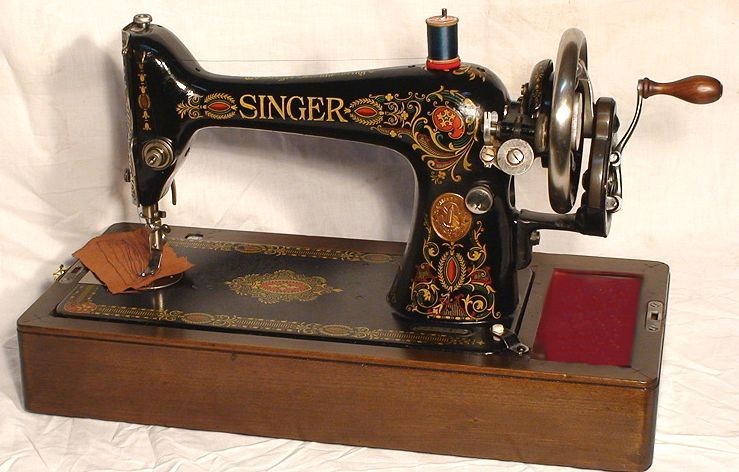 |
| A restored 66 Redeye (removed from the treadle and made into a hand-crank) |
 |
| A restored treadle |
66s are, in their original form, treadle machines. A treadle machine is housed in a treadle cabinet with a wrought iron pedal and wheel base. A leather cord is connected to the iron wheel and the machine flywheel on the side. When the pedal is pumped via the foot, the iron wheel turns the flywheel and voila! It sews!
"Oscillating hook" refers to how the machine actually stitches. Modern machines (machines post-dating 1950) are usually rotary hook machines. Rotary hook machines pull bobbin thread in one direction (clockwise, usually). Oscillating hooks move in one direction, then back again, hence the name "oscillating." This really has no bearing on the quality of the stitch and mostly just affects threading.
"Oscillating hook" refers to how the machine actually stitches. Modern machines (machines post-dating 1950) are usually rotary hook machines. Rotary hook machines pull bobbin thread in one direction (clockwise, usually). Oscillating hooks move in one direction, then back again, hence the name "oscillating." This really has no bearing on the quality of the stitch and mostly just affects threading.
66 Redeyes are not rare. You can find them pretty much all over the place in a variety of conditions (horrible to almost mint) for very little money. It certainly doesn't have the collectible esteem that say a Singer Featherweight has. Fleta in particular has been through a lot. The Harper farm was all but completely repossessed during the Great Depression (my grandmother recalled watching the bank haul away their farming equipment when she was a girl), and while I don't know if Grandmother Harper owned "Miss Fleta" during the Depression, if she did, it's pretty amazing that she wasn't repossessed.
These are true workhorses. I would not recommend the Singer brand in its current incarnation, but original Singers (up through the 1950s) manufactured in Jersey are real treats to sew on.
She looks pretty rough, but I am determined to get her sewing again and looking spiffy. She has "seen" a lot in almost 100 years: surreys, women's suffrage, the sinking of the Titanic, Model-Ts, 2 World Wars, V-Day, the Great Depression, prohibition, the first television, the first man on the moon, the assassination of JFK and MLK, Jr., the Civil-Rights Movement, Vietnam, and probably countless Harper family gatherings, Christmases, and birthdays. She is beautiful and probably meant a lot to Grandmother Harper, so she deserves some TLC, I think!
Tune in for restoration progress and photos!


No comments:
Post a Comment